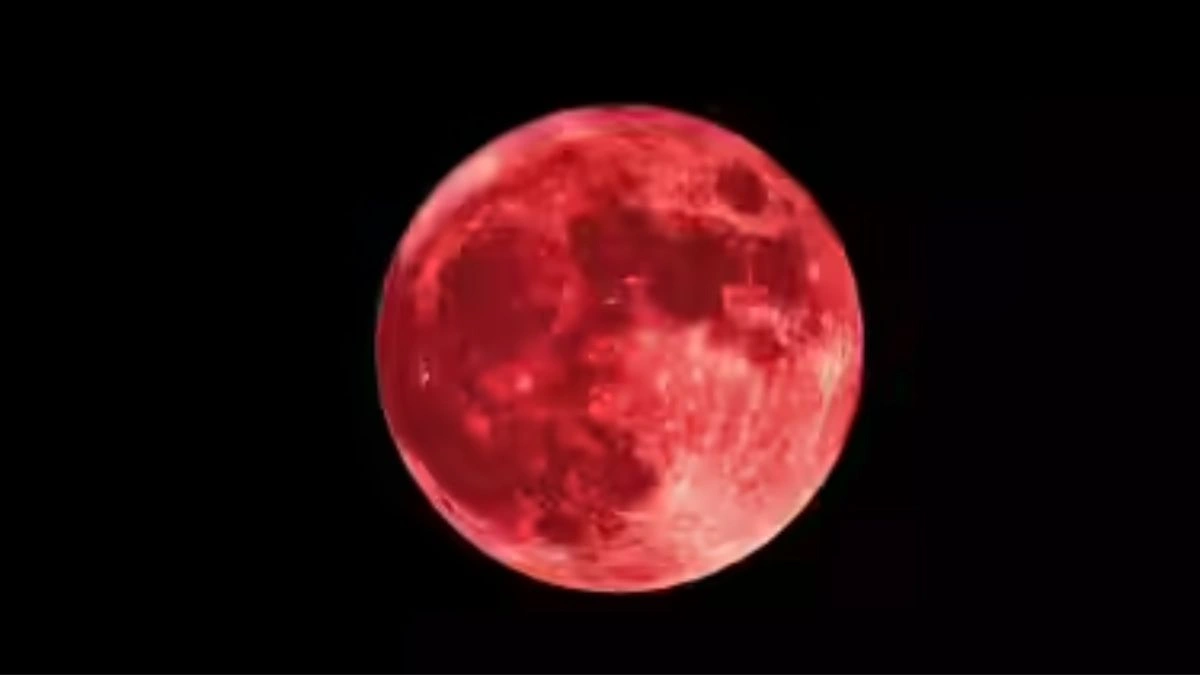
Canadians are set to witness a breath taking celestial event overnight and into the early morning hours as a total lunar eclipse transforms the moon into a striking “blood moon.” According to NASA, the eclipse will be visible across Canada, offering skywatchers a rare and captivating astronomical spectacle.
What Is a Total Lunar Eclipse?
A total lunar eclipse takes place when the Earth moves directly between the Sun and the Moon. During this alignment, Earth casts a vast shadow across the lunar surface.
As sunlight filters through Earth’s atmosphere, shorter blue wavelengths scatter while longer red wavelengths pass through, bathing the Moon in a deep reddish-orange hue. This phenomenon gives rise to the popular term “blood moon.”
Such an alignment is only possible during a full moon phase, when the Sun, Earth, and Moon line up in near-perfect formation. Unlike solar eclipses, which require protective eyewear, a lunar eclipse can be viewed safely with the naked eye.
Timing and Visibility Across Canada
The eclipse will unfold gradually over several hours, making it easy for viewers to catch different phases of the event. Here is the official schedule provided by NASA:
- Penumbral phase begins: 3:44 a.m. Eastern (12:44 a.m. Pacific)
- Totality begins: 6:04 a.m. Eastern (3:04 a.m. Pacific)
- Duration of totality: Approximately one hour
- Eclipse ends: 9:23 a.m. Eastern (6:23 a.m. Pacific)
The most dramatic moment—totality—will last about an hour, during which the Moon will appear fully immersed in Earth’s shadow.
Because the event is visible nationwide, Canadians from coast to coast can enjoy the display, weather permitting. A clear, cloud-free sky will offer the best viewing conditions.
Why Lunar Eclipses Are Easy to Watch
Unlike a solar eclipse, which can last only a few minutes at its peak and requires specialized glasses, a lunar eclipse unfolds at a more relaxed pace. As noted by Catherine Miller of Middlebury College’s Mittelman Observatory in comments to The Associated Press, lunar eclipses provide a slower, more comfortable viewing experience.
There is no need for telescopes or protective eyewear—though binoculars can enhance the view. Simply step outside during the scheduled times and look toward the night sky.
How Often Do Lunar and Solar Eclipses Occur?
Eclipses are not exceedingly rare, but total lunar eclipses visible in a specific region do not happen frequently. According to NASA, solar and lunar eclipses occur between four and seven times each year worldwide. However, their visibility depends on geographic location.
Looking ahead, a partial lunar eclipse is expected in August and will be visible across the Americas, Europe, Africa, and western Asia. Meanwhile, the next total lunar eclipse after this event is anticipated in late 2028.
What Makes the ‘Blood Moon’ So Special?
The reddish coloration during totality is caused by Earth’s atmosphere bending sunlight toward the Moon. The more dust or particles in the atmosphere, the deeper the red shade may appear. This gives each total lunar eclipse a slightly unique appearance.
For astronomy enthusiasts and casual skywatchers alike, a blood moon offers a chance to witness the intricate alignment of celestial bodies in real time. The extended duration also makes it easier to photograph compared to solar eclipses.
Conclusion
The upcoming total lunar eclipse promises a stunning overnight spectacle for Canadians from coast to coast. With totality lasting about an hour and no special equipment required, this blood moon event offers an accessible and unforgettable opportunity to observe Earth’s shadow sweeping across the lunar surface.
As confirmed by NASA, viewers simply need clear skies and a willingness to look up. With the next total lunar eclipse not expected until late 2028, this is a celestial show worth staying up for.